
Dataset Splitter mechanics#
This notebook will make use of dataset’s split method and why use it to get balanced datasets
The goal is to split a dataset into train and valid which are respectively 90% and 10% of the dataset (image wise)
[1]:
%load_ext autoreload

%autoreload 2
import matplotlib.pyplot as plt
import pandas as pd
import seaborn
from ot import dist, emd2, sinkhorn2

from lours.dataset import from_coco
from lours.utils import grouper

pd.set_option("max_colwidth", 20)
Example setup#
This will be used as an example
Some splitting methods can be slow (could be sped up with multiprocessing, stay tuned !) so we keep the dataset small for this example
[2]:
coco_valid = "notebook_data/coco_valid.json"
COCO_dataset = from_coco(coco_valid, images_root=".")
COCO_SC = COCO_dataset.remap_from_preset("coco", "supercategory").iloc_annot[::10]
[3]:
COCO_SC
Let’s check the data repartition for categories and box heights#
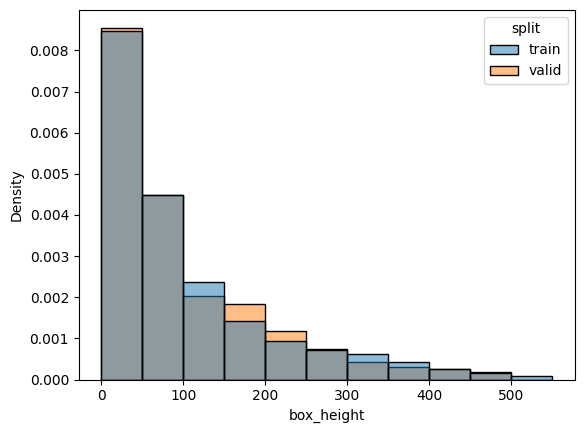
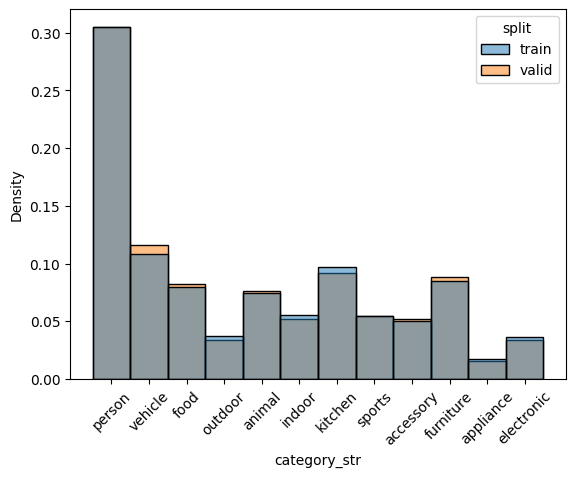
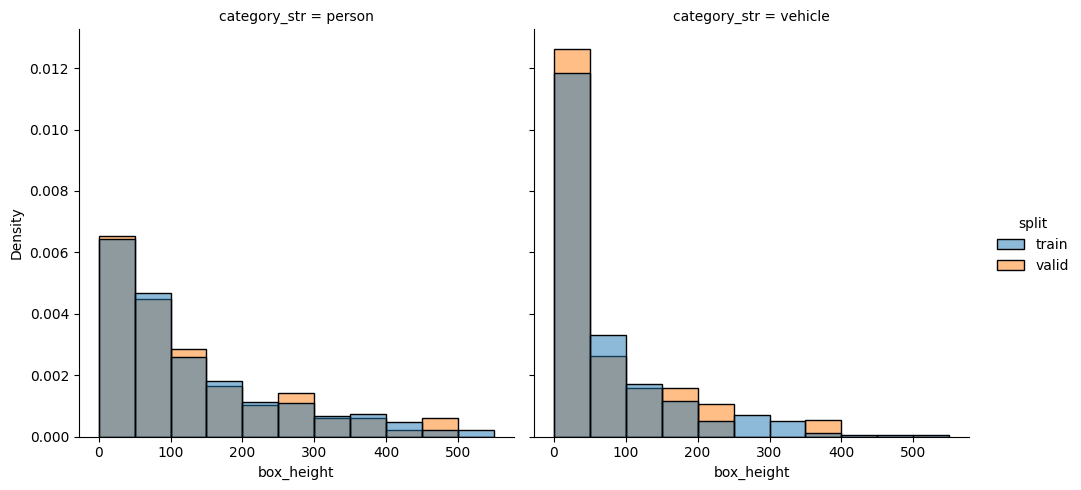
Notice the check_split_conformity will compare different splits. A big overlap between the different histogram will mean balanced splits
[4]:
bins = range(0, 600, 50)


def check_split_conformity(dataset):
    plt.figure()
    seaborn.histplot(
        dataset.annotations,
        x="box_height",
        stat="density",
        hue="split",
        common_norm=False,
        bins=bins,
    )

    plt.figure()
    seaborn.histplot(
        dataset.annotations,
        x="category_str",
        stat="density",
        hue="split",
        common_norm=False,
    )
    plt.xticks(rotation=45)
    plt.show()

    person_sedan = dataset.annotations[
        COCO_SC.annotations["category_str"].isin(["person", "vehicle"])
    ]
    plt.figure()
    seaborn.displot(
        person_sedan,
        x="box_height",
        col="category_str",
        hue="split",
        stat="density",
        common_norm=False,
        bins=bins,
    )
    plt.show()

    cutted = (
        pd.cut(dataset.annotations["box_height"], bins=bins)
        .apply(lambda x: x.left)
        .astype(float)
    )
    target_hist = dataset.annotations.groupby(cutted).size()
    for split, group in dataset.annotations.groupby("split"):
        cutted = (
            pd.cut(group["box_height"], bins=bins).apply(lambda x: x.left).astype(float)
        )
        candidate_hist = dataset.annotations.groupby(cutted).size()
        left_bins = target_hist.index.to_numpy()
        right_bins = candidate_hist.index.to_numpy()
        distance_matrix = dist(
            left_bins[:, None], right_bins[:, None], metric="cityblock"
        )
        distance_matrix = distance_matrix / distance_matrix.max()

        normalized_left = (target_hist / target_hist.sum()).to_numpy()
        normalized_right = (candidate_hist / candidate_hist.sum()).to_numpy()
        emd = emd2(normalized_left, normalized_right, distance_matrix)
        sinkhorn = sinkhorn2(
            normalized_left, normalized_right, distance_matrix, reg=1e-1
        )
        print(
            f"EMD and sinkhorn between target and {split} for box height :"
            f" {emd} {sinkhorn}"
        )
[5]:
check_split_conformity(COCO_SC)
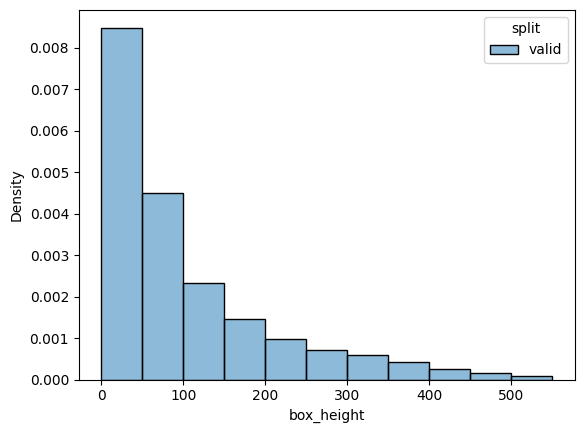
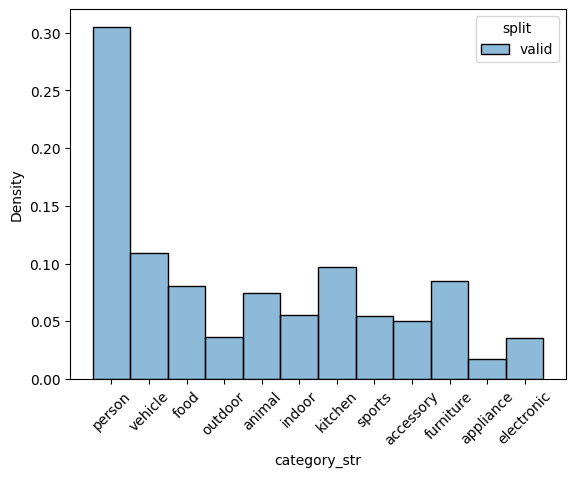
<Figure size 640x480 with 0 Axes>
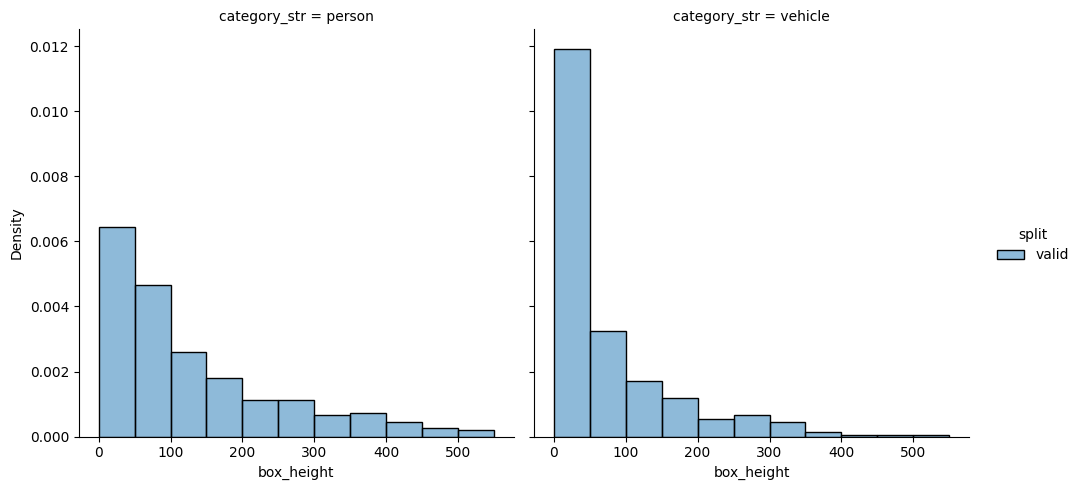
EMD and sinkhorn between target and valid for box height : 0.0 0.05641091212724669
First split try with the most naive way : split dataset dataset in 90%/10% completely randomly and hope for the best#
[6]:
COCO_SC.images.split = None
splitted_COCO_naive = COCO_SC.split(
    input_seed=0,
    split_names=["train", "valid"],
    target_split_shares=[0.9, 0.1],
    keep_separate_groups=["image_id"],
    keep_balanced_groups=[],
)
Using simple random split
[7]:
check_split_conformity(splitted_COCO_naive)
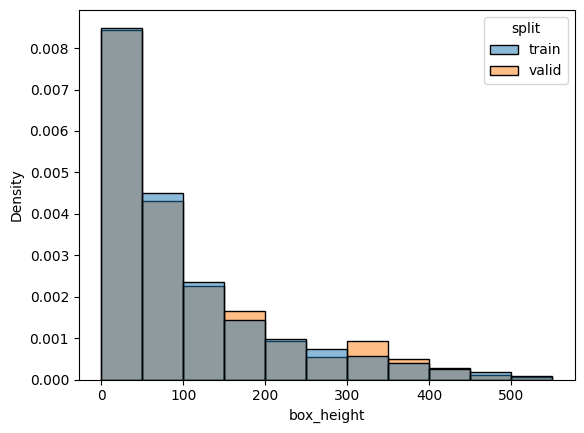
<Figure size 640x480 with 0 Axes>
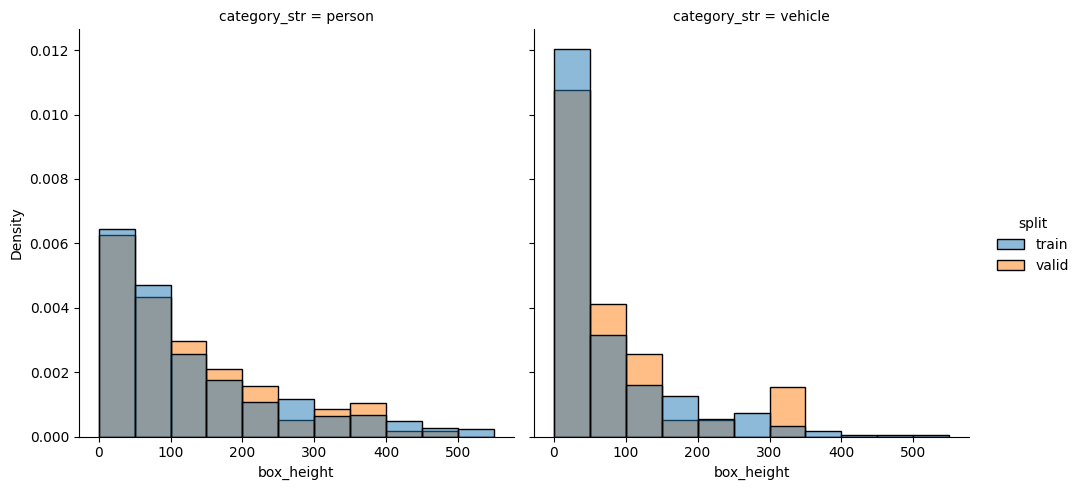
EMD and sinkhorn between target and train for box height : 0.0008374786384173133 0.056398522126405976
EMD and sinkhorn between target and valid for box height : 0.007599599545307657 0.057616027043828816
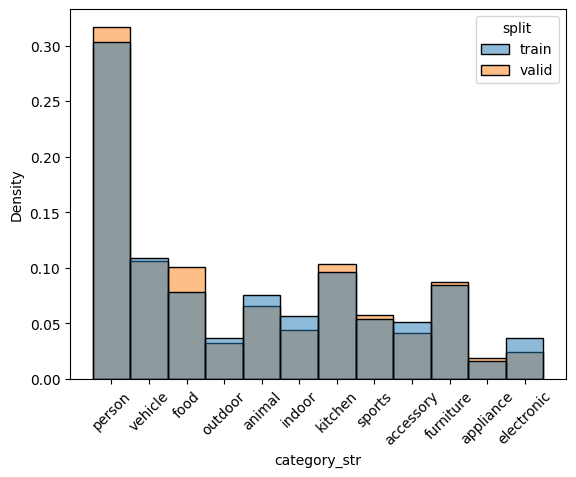
Splitted dataset is not too bad, but we can do better, especially for classes. For example, electronic is not well represented in train split.
Split while keeping categories balanced#
Now, we can try with “category_id” as dataset class we want to keep balanced. Note that this is the default behaviour.
[8]:
splitted_COCO_balanced_category = COCO_SC.split(
    input_seed=1,
    split_names=["train", "valid"],
    target_split_shares=[0.9, 0.1],
    keep_separate_groups=["image_id"],
    keep_balanced_groups=["category_id"],
    share_cost_weight=0,
)
Splitting annotations ...
Separating input data into atomic chunks
2699 chunks to distribute across 2 splits
Splitting images ...
Separating input data into atomic chunks
2301 chunks to distribute across 2 splits
[9]:
check_split_conformity(splitted_COCO_balanced_category)
<Figure size 640x480 with 0 Axes>
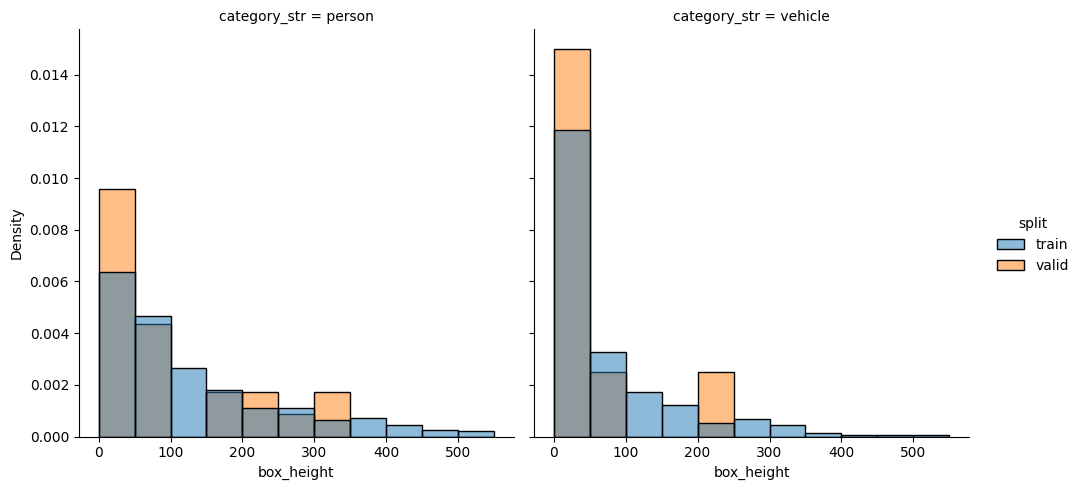
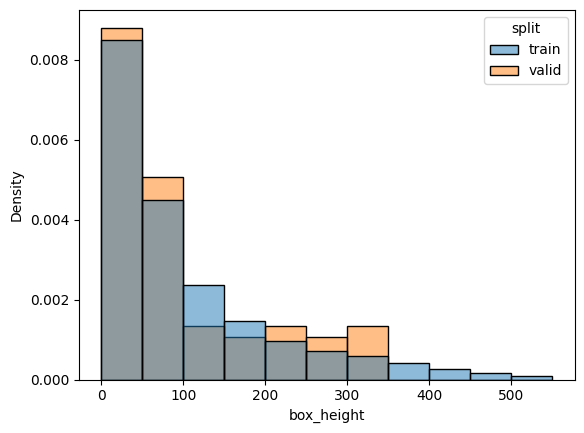
EMD and sinkhorn between target and train for box height : 0.0004139281770258621 0.05643086435154283
EMD and sinkhorn between target and valid for box height : 0.019769209734755263 0.06296603442654297
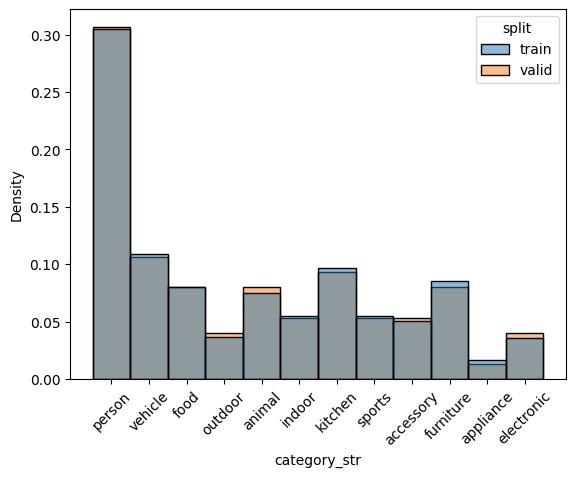
Class repartition is almost perfect, but box height is still not perfect.
Split while keeping box height balanced#
Let’s try to use that instead of “category_id”
[10]:
box_height_group = grouper.ContinuousGroup("box_height", bins)
[11]:
import warnings

warnings.filterwarnings("ignore")
splitted_COCO_balanced_height = COCO_SC.split(
    input_seed=1,
    split_names=["train", "valid"],
    target_split_shares=[0.1, 0.9],
    keep_separate_groups=["image_id"],
    keep_balanced_groups=[box_height_group],
    earth_mover_regularization=0,
)
Splitting annotations ...
Separating input data into atomic chunks
2699 chunks to distribute across 2 splits
Splitting images ...
Separating input data into atomic chunks
2301 chunks to distribute across 2 splits
[12]:
check_split_conformity(splitted_COCO_balanced_height)
<Figure size 640x480 with 0 Axes>
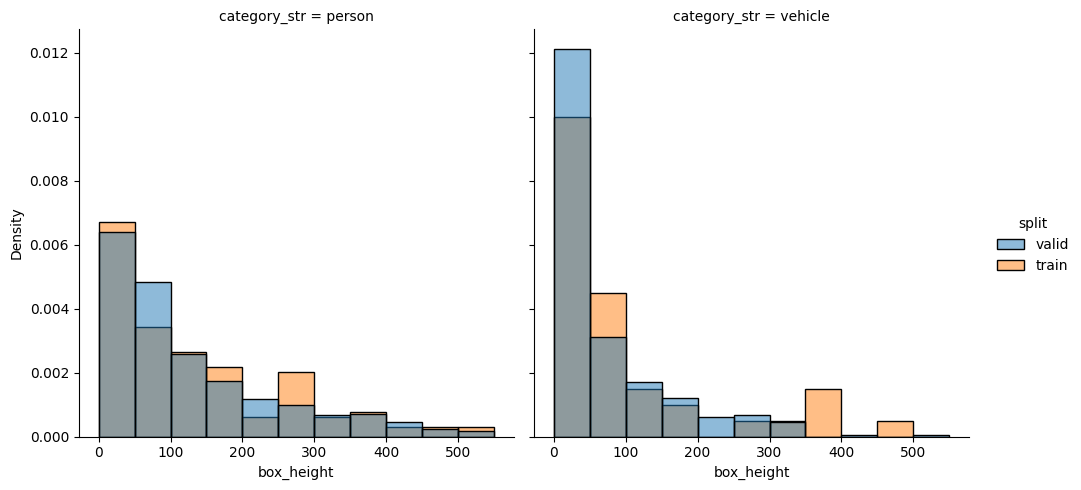
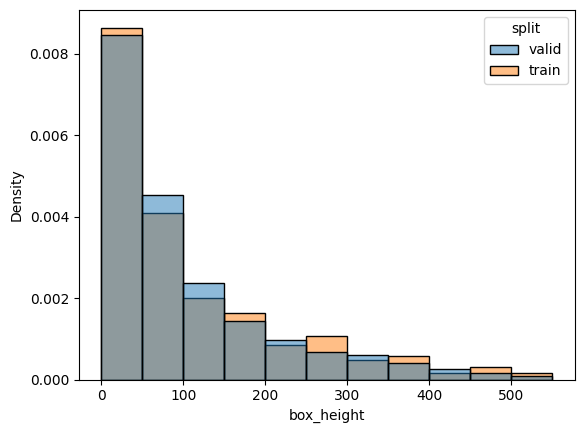
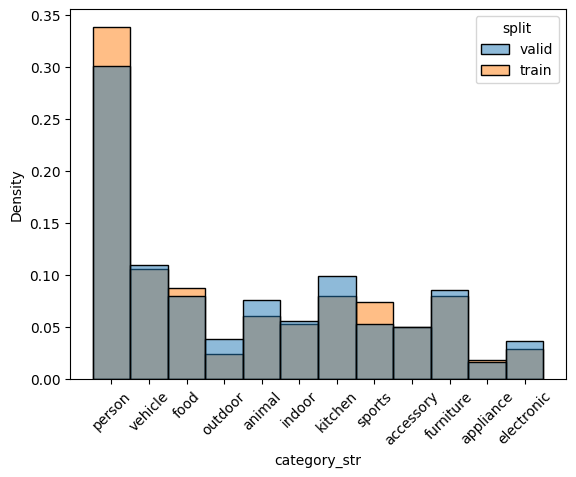
EMD and sinkhorn between target and train for box height : 0.013802532695916195 0.05937297935238999
EMD and sinkhorn between target and valid for box height : 0.001586449642183014 0.05644621532682227
General box repartition is good, but not per class. Also, some class repartition is not good, e.g. outdoor.
Split while keeping both categories and box height balanced#
We can actually solve the problem by asking for balanced repartition for both classes and box heights.
[13]:
splitted_COCO_balance_mixed = COCO_SC.split(
    input_seed=1,
    split_names=["train", "valid"],
    target_split_shares=[0.9, 0.1],
    keep_separate_groups=["image_id"],
    keep_balanced_groups=["category_id", box_height_group],
    earth_mover_regularization=0,
)
Splitting annotations ...
Separating input data into atomic chunks
2699 chunks to distribute across 2 splits
Splitting images ...
Separating input data into atomic chunks
2301 chunks to distribute across 2 splits
[14]:
check_split_conformity(splitted_COCO_balance_mixed)
<Figure size 640x480 with 0 Axes>
EMD and sinkhorn between target and train for box height : 0.0007947231394608702 0.05641936768280836
EMD and sinkhorn between target and valid for box height : 0.008147746155949598 0.05799456298767276